
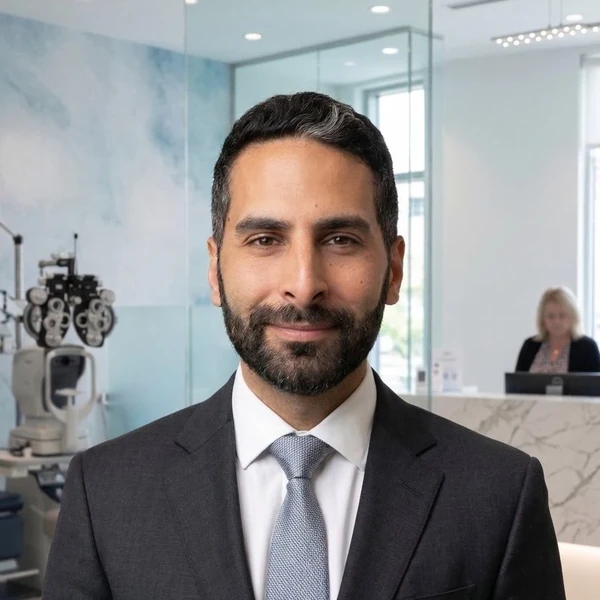
Are you finding near vision increasingly difficult and wondering whether laser surgery could free you from it? Determining whether you are a candidate for presbyopia surgery is the essential first step before any treatment. In this article, Dr Gozlan details the eligibility criteria, the pre-operative assessment and the contraindications you need to know in order to find out whether Presby-LASIK or Presby-PRK is right for you.
Candidate for presbyopia surgery: understanding the stakes before you commit
Presbyopia is a universal physiological process linked to the ageing of the crystalline lens. It usually appears between the ages of 42 and 48 and progresses until around 60, making reading without glasses more and more difficult. Refractive laser surgery — Presby-LASIK or Presby-PRK — reshapes the cornea to create a multifocal profile, thereby restoring functional vision at all distances. However, not every presbyopic patient is automatically a candidate for presbyopia surgery. A thorough ophthalmic assessment is essential to evaluate the feasibility and safety of the procedure.
The ideal profile of a candidate for presbyopia surgery with Presby-LASIK
The ideal Presby-LASIK profile combines several precise characteristics. A candidate for presbyopia surgery should meet the following criteria:
- Age: between 45 and 65, the period when presbyopia is established and stable enough for a lasting correction;
- Refractive stability: the glasses prescription must no longer change significantly for at least 12 months;
- Sufficient corneal thickness: a pachymetry above 500 microns is generally required for Presby-LASIK;
- No progressive eye disease: no uncontrolled glaucoma, significant cataract or maculopathy;
- Motivation and realistic expectations: the candidate must understand that the goal is maximum independence from glasses, without a guarantee of absolute perfection;
- Normal corneal topography: the absence of keratoconus or corneal irregularity is checked during the presbyopia pre-operative assessment.
The pre-operative assessment: a key step for any candidate for presbyopia surgery
The presbyopia pre-operative assessment is the decision-making foundation of refractive surgery. During this in-depth consultation, Dr Gozlan performs a set of complementary examinations to confirm or rule out the patient's Presby-LASIK eligibility:
- Corneal topography: detailed mapping of the curvature and regularity of the cornea;
- Pachymetry: precise measurement of central and peripheral corneal thickness;
- Aberrometry: analysis of the eye's optical aberrations to personalise the laser treatment;
- Dilated fundus examination: examination of the retina and optic nerve to rule out any associated disease;
- Pupillometry: assessment of pupil diameter under scotopic conditions, decisive for the multifocal treatment zone;
- Ocular dominance test: identification of the dominant eye, essential in a monovision or multifocality strategy.
This comprehensive assessment makes it possible to establish whether the patient is genuinely a candidate for presbyopia surgery and to choose the most suitable technique between Presby-LASIK and Presby-PRK.
Contraindications: when you are not a candidate for presbyopia surgery
Certain clinical situations represent absolute or relative contraindications to presbyopia surgery. Knowing them is essential to ensure patient safety:
- Confirmed or suspected keratoconus: this progressive corneal deformation rules out any further laser thinning;
- Early or advanced cataract: clouding of the crystalline lens points instead towards replacement with a multifocal implant;
- Severe dry eye syndrome: significant ocular dryness may worsen after corneal surgery;
- Cornea too thin: a pachymetry below 480 microns contraindicates LASIK, but Presby-PRK may still be an option;
- Active autoimmune diseases: lupus, rheumatoid arthritis or other conditions affecting healing;
- Pregnancy or breastfeeding: hormonal fluctuations temporarily alter refraction.
When a patient is not a candidate for presbyopia surgery with the laser, Dr Gozlan offers alternatives such as multifocal implants or progressive lenses.
Candidate for presbyopia surgery with an associated refractive error
Most presbyopic patients also have myopia, hyperopia or astigmatism. The good news is that Presby-LASIK can correct presbyopia and the associated refractive error simultaneously in a single procedure. A short-sighted candidate for presbyopia surgery often achieves excellent results, because myopia partially compensates for presbyopia in near vision. The hyperopic presbyope, on the other hand, is doubly penalised — both near and far — and is often the most motivated and most satisfied candidate after the operation. Moderate astigmatism (up to 3-4 dioptres) is corrected during the same operative session thanks to personalised ablation profiles.
Expected results for a well-selected candidate for presbyopia surgery
When the presbyopia pre-operative assessment confirms eligibility and the candidate for presbyopia surgery is correctly selected, the results are very encouraging. More than 90% of patients operated on with Presby-LASIK achieve independence from glasses for everyday activities: reading, computer screens, driving. Visual recovery is rapid — a few hours for LASIK — and overall satisfaction exceeds 95% in published studies. It is important, however, to point out that a pair of back-up glasses may still be useful for prolonged reading in low light or for very small print. This transparency about results is an integral part of the consultation and helps to set realistic expectations for every candidate for presbyopia surgery.
When to consult Dr Gozlan if you are a candidate for presbyopia surgery
If you are over 45, find near vision increasingly difficult and wish to reduce your dependence on glasses, it is time to undergo an eligibility assessment. Dr Gozlan supports you at every step to determine whether you are a candidate for presbyopia surgery and to guide you towards the technique best suited to your situation. Do not wait for presbyopia to affect your quality of life further: a specialist consultation will give you clear, personalised answers.
📍 Consultation at the Paris – Auteuil Ophthalmology Practice
Dr Gozlan, an ophthalmic surgeon specialising in refractive presbyopia surgery at the Paris – Auteuil Ophthalmology Practice, welcomes you for your assessment and treatment.
Book an Appointment on DoctolibFAQ: candidate for presbyopia surgery — frequently asked questions
From what age can you be a candidate for presbyopia surgery?
The recommended minimum age is generally 45, when presbyopia is sufficiently established to justify a surgical correction. Before this age, presbyopia is still progressing too rapidly, which would limit the durability of the result.
Can you be a candidate for presbyopia surgery if you have already had myopia surgery?
Yes, in most cases a history of LASIK for myopia does not contraindicate presbyopia surgery. The presbyopia pre-operative assessment will check the residual corneal thickness and the regularity of the cornea to confirm feasibility.
What are the main contraindications to being a candidate for presbyopia surgery?
The major contraindications include keratoconus, significant cataract, a cornea that is too thin and active autoimmune diseases. Severe dry eye syndrome is also a relative contraindication that requires prior treatment.
Is the assessment to become a candidate for presbyopia surgery painful?
No, the pre-operative assessment is completely painless. It includes a series of non-invasive examinations — topography, pachymetry, aberrometry — that last about 45 minutes to an hour. Only the instillation of drops to dilate the pupil may cause slight temporary discomfort.
How long does it take to find out if you are a candidate for presbyopia surgery?
Dr Gozlan usually gives his answer at the end of the pre-operative assessment, during the same consultation. You leave with a clear opinion on your eligibility and, where appropriate, a proposed surgical schedule.
Going further
- Presby-LASIK: the most widespread multifocal technique for presbyopia;
- Presby-PRK: an alternative for thin corneas;
- Presby-LASIK vs Presby-PRK comparison: all the differences explained.