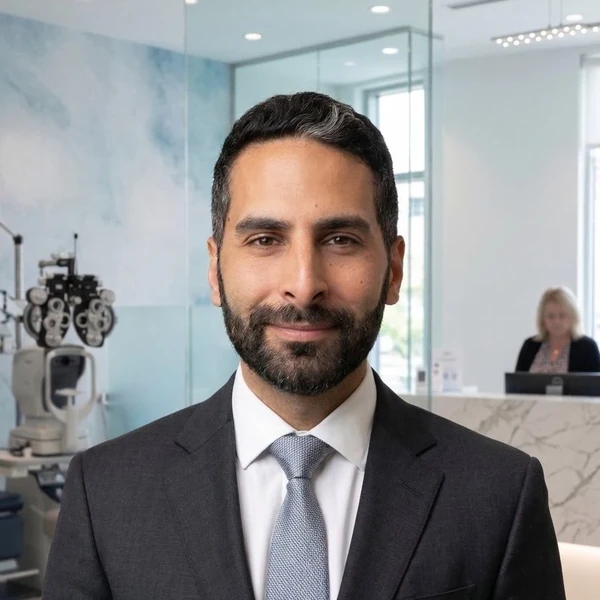
Presby-LASIK or Presby-PRK to correct presbyopia with laser? The complete comparison of the two techniques, point by point, with Dr Gozlan.
Presby-LASIK or Presby-PRK ? These two laser presbyopia surgery techniques are based on the same optical principle — giving the cornea a multifocal profile or applying micro-monovision — to restore comfortable near vision without sacrificing distance vision. They differ in only one respect : the way the cornea is accessed. This comprehensive comparison details, point by point, everything that separates Presby-LASIK from Presby-PRK. The final decision always depends on the preoperative assessment by Dr Gozlan, holder of the University Diploma in Refractive Surgery and Phacoemulsification.
Presby-LASIK and Presby-PRK are two variants of corneal refractive surgery dedicated to presbyopia. Both reshape the cornea using an excimer laser to compensate for the age-related loss of accommodation. Presby-LASIK works beneath a corneal flap, while Presby-PRK acts on the surface : these are two pathways to the same goal — freedom from reading glasses.
As with myopia (nearsightedness) surgery, the entire difference lies in how the cornea is accessed :
From this single difference stem the speed of recovery, the level of comfort, and the indications based on corneal thickness.
Both techniques share the essentials : the same excimer laser, the same two optical strategies (a multifocal cornea or micro-monovision), the same anaesthesia with eye drops, the same outpatient setting, the same preoperative workup (near and distance refraction, dominant eye determination, micro-monovision trial, topography, pachymetry), and comparable neuro-adaptation. For a given optical profile, the near vision outcome is equivalent.
This is the most noticeable difference in daily life. With Presby-LASIK, vision is functional from the next day. With Presby-PRK, the time needed for the epithelium to regenerate means useful vision returns within 3 to 7 days and then refines over 1 to 3 months. On top of this, both procedures require a period of neuro-adaptation to multifocal vision.
Both procedures are painless during surgery. Presby-LASIK is very comfortable from the same evening ; Presby-PRK involves some discomfort for 2 to 3 days while the surface heals. In both cases, the brain must adapt to multifocality or micro-monovision : over a few days to a few weeks, distance vision may seem slightly less sharp before full comfort is achieved.
Corneal thickness is often the decisive factor. The Presby-LASIK flap uses up tissue : on a thin cornea, Presby-PRK, which works on the surface, becomes the safest option. Topography and pachymetry from the preoperative workup provide an objective answer.
For contact-sport athletes and occupations exposed to ocular trauma, Presby-PRK is generally recommended : the absence of a flap eliminates any risk of displacement from impact.
Both techniques correct, in the same session as presbyopia, associated myopia (nearsightedness), hyperopia or astigmatism. Details on the laser correction of these refractive errors are provided on the dedicated myopia surgery website.
Literature reviews show good independence from reading glasses with both approaches, with distance vision being preserved (systematic review, Eye, 2023 ; Arba Mosquera & Verma, 2017). For an equivalent optical profile, the near vision outcome is comparable ; only the speed of recovery and initial comfort differ. Neither procedure halts the ageing of the crystalline lens.
Both corneal techniques are suitable as long as the natural lens remains clear. When presbyopia is very advanced or an early cataract is developing, it may be more appropriate to replace the natural lens with a multifocal intraocular lens: this is refractive lens exchange, which involves a separate treatment pathway. The preoperative assessment guides the decision based on age and the condition of the lens.
In both cases, refractive surgery for presbyopia is not covered by national health insurance. Many supplemental insurance plans offer a "refractive surgery" allowance applicable to both Presby-LASIK and Presby-PRK. A detailed quote is provided during your consultation, with no obligation.
At a glance, the main differences :
| Criterion | Presby-LASIK | Presby-PRK |
|---|---|---|
| Technique | Corneal flap created with femtosecond laser | Surface treatment, no flap |
| Optical principle | Corneal multifocal / micro-monovision | Corneal multifocal / micro-monovision |
| Visual recovery | 24 to 48 hours | 3 to 7 days, refinement over 1–3 months |
| Post-operative comfort | Excellent from the next day | Discomfort for 2–3 days (bandage contact lens) |
| Thin corneas | Less suitable | Preferred indication |
| Contact sports / high-risk occupations | Flap not recommended | Ideal (no flap) |
| Neuro-adaptation | A few days to weeks | A few days to weeks |
| Associated refractive errors | Corrected at the same time | Corrected at the same time |
| Specific risk | Flap-related; halos | Corneal haze (rare); halos |
| Near vision outcome | Good | Good (equivalent) |
| Reimbursement | Not covered | Not covered |
This table is for guidance only : only the pre-operative assessment can personalise the recommendation.
There is no single " best " technique in absolute terms : there is the one that best suits your eyes. Presby-LASIK is often preferred for its rapid recovery when the cornea allows it ; Presby-PRK is indicated for thin corneas, contact-sport athletes, and high-risk occupations. The decision depends on the thickness and regularity of the cornea, the condition of the crystalline lens, your lifestyle, and your expectations. This is precisely the purpose of the preoperative assessment.
Neither is "better" in absolute terms: they rely on the same optical principle and deliver an equivalent outcome for near vision. Presby-LASIK recovers faster; Presby-PRK is ideal for thin corneas and athletes. The assessment decides.
Yes. Both give the cornea a multifocal profile or apply micro-monovision to restore near vision while preserving distance vision. Most patients can do without reading glasses in daily life.
Presby-LASIK: vision is functional by the next day. With Presby-PRK, useful vision returns within 3 to 7 days and then refines over a few weeks.
The procedure is painless in both cases. Afterwards, Presby-LASIK is very comfortable from the next day, whereas Presby-PRK causes discomfort for 2 to 3 days.
Presby-PRK is preferred, as it works on the surface and preserves corneal thickness. The assessment confirms eligibility.
Presby-PRK, because the absence of a flap eliminates any risk of displacement from an impact to the eye.
Yes. The brain must adjust to multifocal vision or micro-monovision: a few days to a few weeks, regardless of the technique.
Yes, with both techniques: associated myopia, hyperopia or astigmatism are corrected in the same session as presbyopia.
When the lens becomes opaque, lens surgery with a multifocal implant may be more appropriate than corneal laser treatment. The assessment guides the decision based on age and lens condition.
Only the preoperative assessment (near and distance refraction, dominant eye, micro-monovision test, topography, pachymetry) can determine the answer, based on your cornea, your lens and your lifestyle.
Dr Gozlan, holder of the University Diploma in Refractive Surgery and Phacoemulsification, determines during a comprehensive assessment whether Presby-LASIK or Presby-PRK is the safest and most suitable technique for your eyes.
Book an appointment on DoctolibReferences & medical sources