
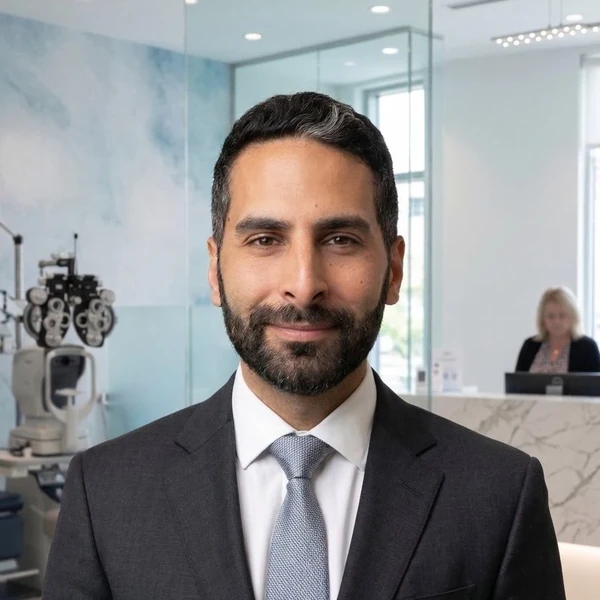
After reaching the age of forty, reading gradually becomes more difficult and arms seem too short to decipher a menu or a phone screen. This universal phenomenon has a name: presbyopia. Understanding the causes of presbyopia is essential for considering appropriate solutions, particularly refractive surgery using Presby-LASIK or Presby-PRK as offered by Dr Gozlan.
Causes of presbyopia: definition and fundamental mechanism
Presbyopia is a near-vision disorder related to the natural aging of the eye's internal optical system. Unlike myopia or hyperopia, which result from an anomaly in the shape of the eyeball, the causes of presbyopia lie in the progressive loss of crystalline lens flexibility and the weakening of the ciliary muscle. This physiological process affects 100% of the population, without exception, generally from the age of 40–45 onward.
Ocular accommodation refers to the eye's ability to alter the curvature of the crystalline lens to focus on objects at varying distances. When this ability diminishes, the image of near objects is formed behind the retina, producing characteristic visual blur.
Crystalline lens rigidity: the primary cause of presbyopia
The crystalline lens is a transparent biconvex lens located behind the iris. In younger individuals, it is supple and elastic, capable of rapidly increasing its curvature to focus light from near objects. Over time, several structural changes occur:
- Rigid crystalline lens in presbyopia: the lens fibers compact and lose their elasticity, making deformation of the crystalline lens increasingly difficult;
- Progressive thickening: the crystalline lens grows throughout life by adding new cellular layers, which increases its volume and rigidity;
- Biochemical modification: the crystalline proteins (crystallins) undergo oxidative modifications that harden the internal structure;
- Relative dehydration: the water content of the lens nucleus decreases with age, contributing to sclerosis of the tissue.
This phenomenon of rigid crystalline lens in presbyopia constitutes the determining factor among the causes of presbyopia and explains why no ocular exercise can truly reverse the process.
Causes of presbyopia related to the ciliary muscle and zonule
The crystalline lens does not function in isolation. The ciliary muscle, upon contraction, relaxes the zonular fibers that hold the crystalline lens under tension. This relaxation allows the lens to assume a more convex shape naturally. Among the causes of presbyopia, aging of the ciliary muscle plays a complementary role:
- Loss of contractile force: the ciliary muscle gradually weakens, reducing the amplitude of accommodation;
- Geometric modification: the diameter of the ciliary muscle changes with age, altering the angle of action on the zonular fibers;
- Zonular fibrosis: the fibers of the zonule of Zinn lose elasticity, limiting the mechanical transmission between muscle and crystalline lens.
All of these alterations together constitute a system of progressive failure, explaining why the progression of presbyopia is gradual and inexorable.
Progression of presbyopia: causes of presbyopia at each decade
The progression of presbyopia follows a predictable pattern well known to every ophthalmologist. The causes of presbyopia produce their effects according to a relatively consistent timeline:
- 40–45 years: initial symptoms, difficulty with prolonged reading, need for increased lighting. Corrective addition of +0.75 to +1.00 diopter;
- 45–50 years: clear daily discomfort, need for reading glasses. Addition of +1.25 to +1.75 diopters;
- 50–55 years: near vision after 40 significantly reduced, intermediate vision affected. Addition of +2.00 to +2.25 diopters;
- 55–65 years: progressive stabilization toward the maximum addition of +2.50 to +3.00 diopters, near-total loss of accommodation.
This linear progression is directly correlated with the worsening of the causes of presbyopia over the years, primarily lenticular sclerosis.
Aggravating factors and causes of early-onset presbyopia
While presbyopia is inevitable, certain factors can accelerate its onset or worsen its symptoms. The causes of presbyopia with early onset include:
- Uncorrected hyperopia: hyperopic individuals place greater demands on their accommodation, revealing presbyopia earlier;
- Diabetes: glycemic fluctuations alter crystalline lens hydration and accelerate its rigidification;
- Medications: certain treatments (antidepressants, antihistamines, diuretics) possess anticholinergic effects that reduce accommodation;
- UV exposure: oxidative stress accelerates the aging of crystalline proteins;
- Prolonged screen work: while it does not directly cause presbyopia, it reveals symptoms earlier due to intensive demands on near vision.
Identifying these factors during the ophthalmological assessment allows Dr Gozlan to precisely evaluate the evolutionary stage and recommend the most appropriate surgical technique.
Causes of presbyopia and current surgical solutions
Understanding the causes of presbyopia provides better insight into the principles of modern surgical corrections. Since the crystalline lens cannot regain its flexibility, refractive surgery techniques act on the cornea to compensate for the accommodative deficit:
- Multifocal Presby-LASIK: sculpts a multifocal corneal profile allowing vision at all distances without glasses;
- Presby-PRK: same principle of corneal reshaping, without flap creation, suited to thin corneas;
- Monovision: corrects one eye for distance vision and the other for near vision, leveraging cerebral adaptation.
The choice between these approaches depends on the comprehensive preoperative examination, corneal thickness, and the degree of presbyopia progression observed.
When to consult Dr Gozlan about causes of presbyopia
As soon as near vision after 40 becomes uncomfortable — difficulty reading small print, visual fatigue at the end of the day, the need to hold documents at arm's length — it is recommended to consult a refractive surgery specialist. A comprehensive assessment confirms the diagnosis, precisely evaluates the causes of presbyopia in your individual case, and determines your eligibility for Presby-LASIK or Presby-PRK techniques.
📍 Consultation at Cabinet Ophtalmologique Paris – Auteuil
Dr Gozlan, ophthalmic surgeon specializing in refractive surgery for presbyopia at Cabinet Ophtalmologique Paris – Auteuil, is available for your assessment and care.
Book an Appointment on DoctolibFAQ: causes of presbyopia — frequently asked questions
What are the main causes of presbyopia?
The causes of presbyopia are essentially related to the natural aging of the crystalline lens, which loses its flexibility with age. Weakening of the ciliary muscle and rigidification of the zonular fibers also contribute to the decrease in ocular accommodation.
Can the causes of presbyopia be prevented?
No, presbyopia is an inevitable physiological process. No preventive treatment, ocular exercise, or dietary supplement has demonstrated the ability to prevent the causes of presbyopia from producing their effects. However, refractive surgery can effectively correct its consequences.
Are the causes of presbyopia the same for everyone?
The fundamental mechanism — lenticular sclerosis — is universal. However, certain factors such as hyperopia, diabetes, or sun exposure can accelerate the onset of symptoms. The preoperative assessment evaluates the causes of presbyopia specific to each patient.
Does presbyopia worsen indefinitely?
No, the progression of presbyopia generally stabilizes around the age of 60–65, when the crystalline lens has lost virtually all of its accommodative capacity. The maximum corrective addition then reaches approximately +3.00 diopters and does not progress significantly beyond that point.
Does refractive surgery address the causes of presbyopia?
Surgery does not restore the flexibility of the crystalline lens. Presby-LASIK and Presby-PRK compensate for the effects of the causes of presbyopia by reshaping the cornea to create multifocality, enabling clear vision at all distances.
Further reading
- Presby-LASIK: the most widely used multifocal technique for presbyopia;
- Presby-PRK: alternative for thin corneas;
- Presby-LASIK vs Presby-PRK comparison: all the differences explained.