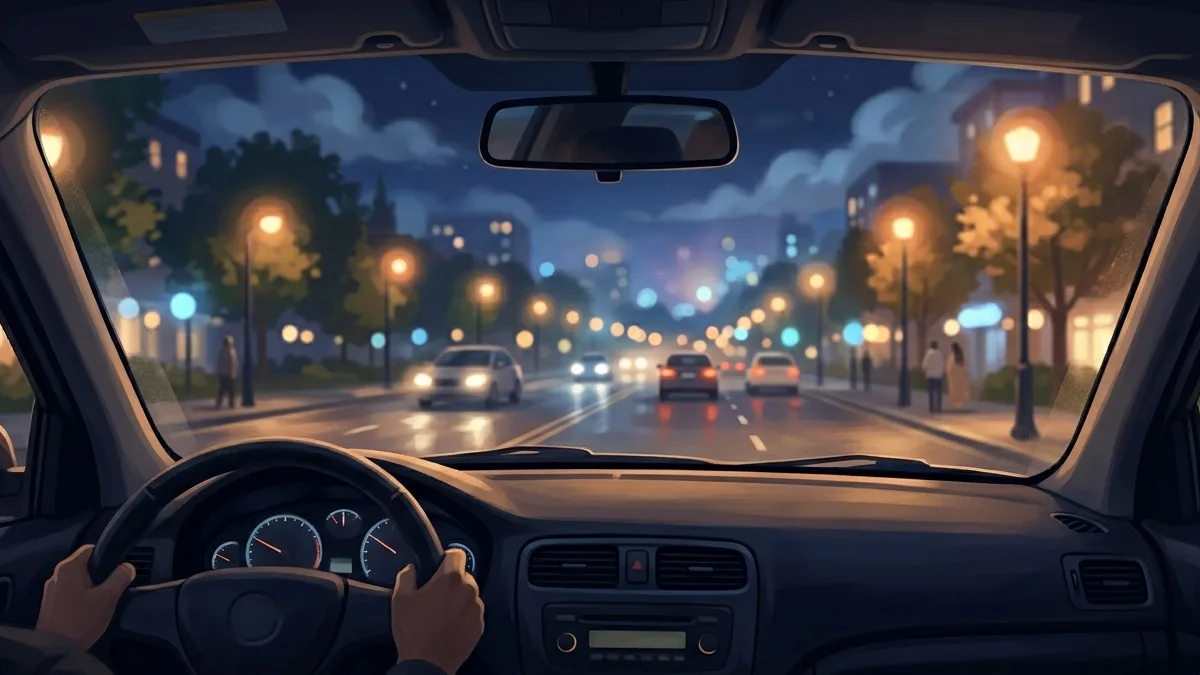
Night driving after Presby-LASIK is one of the main concerns for patients considering refractive surgery for presbyopia. Light halos, glare, reduced contrast: these night-time visual phenomena raise many legitimate questions. This article explains the mechanisms involved, the adaptation timeline and the strategies for regaining optimal visual comfort behind the wheel after surgery.
Night driving after Presby-LASIK: understanding night-time visual phenomena
After Presby-LASIK, the cornea has a multifocal profile created by the excimer laser. This reshaping generates optical transition zones which, when the pupil dilates in low-light conditions, can induce specific visual disturbances. Night driving after Presby-LASIK is therefore directly influenced by the patient's scotopic pupil diameter and the quality of the laser treatment centring.
- Light halos: diffuse rings surrounding point light sources (headlights, streetlights), linked to diffraction at the corneal transition zone;
- Glare: a sensation of a luminous veil caused by light scattering on the reshaped corneal interfaces;
- Reduced contrast sensitivity: difficulty distinguishing shades between dark objects and a dark background, particularly marked in the first few weeks;
- Starburst: light rays radiating from a point source, common in the early healing phase.
Halos and glare: the real impact on night driving after Presby-LASIK
Halos are the symptom most frequently reported. Their intensity varies according to several parameters: the diameter of the treated optical zone, the magnitude of the correction applied and the individual pupil diameter. In clinical practice, around 30 to 40% of patients report moderate halos during the first postoperative month, which can temporarily complicate night driving after Presby-LASIK. However, the vast majority observe a progressive and significant reduction of these phenomena. Glare after presbyopia laser surgery is generally transient and fades as cerebral neuro-adaptation sets in, the brain learning to filter out parasitic visual information.
Night driving after Presby-LASIK: the visual recovery timeline
Night vision quality after refractive surgery follows a well-documented improvement curve. Understanding this timeline helps you anticipate the recovery stages and adapt your driving habits accordingly. Each patient progresses at their own pace, but the main milestones of night driving after Presby-LASIK are relatively predictable.
- Weeks 1 to 2: night driving not recommended; marked halos, visual fluctuations, frequent dry eye;
- Weeks 3 to 6: gradual improvement; night driving after Presby-LASIK becomes possible again on short, familiar routes;
- Months 2 to 3: significant neuro-adaptation; notable reduction in halos and glare;
- Months 3 to 6: definitive stabilisation; most patients regain satisfactory night-time visual comfort;
- Beyond 6 months: final result consolidated; any residual halos are generally well tolerated.
Night driving and presbyopia PRK: how does it differ from LASIK?
Night driving after presbyopia PRK has particularities linked to the surgical technique itself. In Presby-PRK, the absence of a corneal flap means a longer surface epithelial healing, delaying visual stabilisation by several weeks compared with Presby-LASIK. Halos and glare may persist longer — sometimes up to three or four months — but the final result in terms of night vision quality is comparable. Thus, night driving after Presby-LASIK generally regains an optimal level of comfort more quickly than after PRK. The choice between the two techniques depends on corneal thickness, topography and each patient's profile, criteria assessed during the preoperative work-up.
Night driving after Presby-LASIK: practical tips to optimise comfort
Several strategies can improve night driving after Presby-LASIK during the postoperative adaptation phase and beyond.
- Preservative-free artificial tears: instil before getting behind the wheel to maintain a homogeneous tear film and reduce light scattering;
- Anti-reflective coated glasses: even without residual correction, a quality anti-reflective lens significantly attenuates halos and glare;
- Adjusting interior lighting: switch off bright dashboard screens, reduce the GPS brightness;
- Cleaning the windscreen: a dirty windscreen considerably amplifies the scattering of oncoming headlights;
- Avoiding visual fatigue: favour night-time journeys after sufficient eye rest, especially during the first few weeks.
Ideal profiles for good night driving after Presby-LASIK
Not all patients have the same tolerance to night-time photic phenomena. The preoperative work-up helps identify the most favourable profiles for night driving after Presby-LASIK. A scotopic pupil diameter below 5.5 mm, a cornea thick enough to allow a wide optical treatment zone, and moderate presbyopia (addition of +2.00 dioptres or less) are predictive factors of a good outcome. Conversely, patients with very large pupils or those whose profession requires intensive night driving should receive enhanced information and a thorough preoperative simulation.
When to consult Dr Gozlan about night driving after Presby-LASIK?
A follow-up consultation is essential if halos or glare do not improve after three months, if they suddenly worsen, or if night driving after Presby-LASIK remains uncomfortable beyond six months. Additional solutions exist: laser enhancement, optimisation of the corneal profile, prescription of occasional miotic eye drops to reduce the pupil diameter. Dr Gozlan has all the technical equipment needed to analyse night-time visual quality in fine detail (aberrometry, differential topography, scotopic contrast measurement).
📍 Consultation at the Paris – Auteuil Ophthalmology Practice
Dr Gozlan, an ophthalmic surgeon specialising in refractive surgery for presbyopia at the Paris – Auteuil Ophthalmology Practice, sees you for your assessment and your treatment.
Book an Appointment on DoctolibFAQ: night driving after Presby-LASIK — frequently asked questions
How long should I wait before resuming night driving after Presby-LASIK?
It is recommended to wait at least two to three weeks before driving at night. Night driving after Presby-LASIK becomes comfortable for most patients between the second and third postoperative month, once neuro-adaptation is well established.
Are light halos after Presby-LASIK permanent?
No, in the vast majority of cases the halos gradually fade. Around 90% of patients consider these phenomena negligible or absent at six months. Only a very small proportion retain moderate residual halos.
Is night driving after Presby-LASIK harder than after a standard LASIK?
The multifocal profile of Presby-LASIK generates more photic phenomena than unifocal LASIK. However, current optimised corneal profiling technologies and aspheric algorithms have considerably reduced this gap. Night driving after Presby-LASIK is today well tolerated by the vast majority of operated patients.
Are there solutions if night driving after Presby-LASIK remains bothersome?
Yes. The surgeon can offer a laser enhancement to widen the optical zone, prescribe miotic eye drops for occasional use before driving, or recommend specific anti-reflective lenses. A complete aberrometric assessment makes it possible to identify precisely the origin of the discomfort and adapt the management.
Does presbyopia PRK cause more night halos than Presby-LASIK?
Night driving after presbyopia PRK may be disrupted for longer because of the surface epithelial healing. However, once stabilised, night vision quality is equivalent between the two techniques when the indications have been correctly established.
Going further
- Presby-LASIK: the most widespread multifocal technique for presbyopia;
- Presby-PRK: an alternative for thin corneas;
- Presby-LASIK vs Presby-PRK comparison: all the differences explained.