
After the age of 45, almost all adults notice a growing difficulty reading up close. Reading glasses correct the symptom but do nothing to slow the disorder. For anyone seeking a permanent solution for presbyopia, refractive surgery now offers proven techniques — Presby-LASIK and Presby-PRK — capable of durably restoring near vision without relying on corrective lenses.
Understanding presbyopia and its inevitable progression
Presbyopia results from the loss of elasticity of the crystalline lens, which gradually reduces the eye's accommodative capacity. This physiological process begins around age 40-45 and continues until roughly 60-65, when residual accommodation is virtually nil. Unlike myopia, which can stabilise, presbyopia worsens in steady stages, requiring a change of correction every two to three years. It is precisely this progression that makes reading glasses inherently temporary and drives many patients to look for a permanent solution for presbyopia.
Why reading glasses remain a temporary correction
Reading glasses compensate for the accommodative deficit at a given moment. However, they have structural limitations:
- Built-in obsolescence: progression forces a change of lenses every 2-3 years, with an ever-increasing addition;
- Constant dependence: forgetting, breaking, losing them — temporary reading glasses create a daily burden;
- Neglected intermediate vision: single-vision lenses correct only one fixed distance, leaving screen vision blurred;
- Cumulative cost: regular renewal represents a significant budget over twenty years;
- Aesthetic and practical inconvenience: sports, humid environments or demanding professional settings make wearing glasses poorly suited.
Thus, viewing glasses as a satisfactory long-term alternative to presbyopia glasses means ignoring the evolving nature of the disorder. The search for a permanent solution for presbyopia then becomes entirely legitimate.
Permanent solution for presbyopia: the principles of refractive surgery
Refractive surgery for presbyopia aims to reshape the cornea to create a multifocal profile allowing sharp vision at several distances — near, intermediate and far. Two main techniques today constitute a clinically validated permanent solution for presbyopia:
- Presby-LASIK: a corneal flap is cut with a femtosecond laser, then the excimer laser sculpts a customised multifocal profile before the flap is repositioned. Visual recovery is fast, often within 24 hours;
- Presby-PRK: reshaping is performed directly on the surface, without a flap. This permanent presbyopia surgery is preferred for thin corneas or profiles at risk of ocular trauma.
In both cases, treatment is bilateral, outpatient and performed under topical anaesthesia (eye drops). The procedure lasts less than fifteen minutes for both eyes.
Permanent solution for presbyopia with Presby-LASIK: what concrete results?
Clinical studies show that more than 90% of patients operated on with Presby-LASIK achieve independence from reading glasses for everyday activities. Overall satisfaction exceeds 95% one year after surgery. The corneal multifocal profile created is stable over time, which confirms the durable nature of this permanent solution for presbyopia. When associated refractive errors are present — myopia, hyperopia, astigmatism — the treatment corrects them simultaneously, providing optimised overall vision without any optical aid.
Ideal candidates for a permanent solution for presbyopia
Not all presbyopic patients are eligible in the same way. A complete preoperative assessment determines the most suitable technique. Ideal candidates for a permanent solution for presbyopia generally show the following characteristics:
- Age: between 45 and 65, the period when presbyopia is established and measurable;
- Refractive stability: no significant change in correction for at least one year;
- Sufficient corneal thickness: an essential parameter validated by topography and pachymetry;
- Absence of progressive eye disease: early cataract, keratoconus or uncontrolled glaucoma are contraindications;
- Motivation and realistic expectations: the patient must understand that a slight cerebral adaptation is needed over a few weeks.
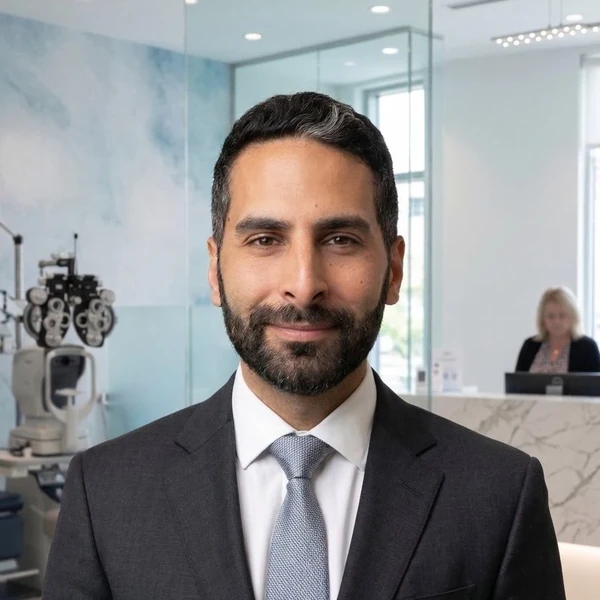
Dr Gozlan assesses each case individually to ensure that permanent presbyopia surgery brings a real and safe benefit.
Comparing the options: where does the permanent solution for presbyopia stand?
Faced with presbyopia, several alternatives to glasses exist. Here is a comparative overview to place surgical correction against the other options:
- Progressive glasses: complete but cumbersome correction, requiring regular renewal;
- Multifocal contact lenses: an interesting but temporary alternative to presbyopia glasses, with infectious risks linked to prolonged wear;
- Presby-LASIK / Presby-PRK: the only permanent solution for presbyopia correcting the defect structurally and lastingly;
- Multifocal intraocular implants: reserved for presbyopic patients with early cataract, involving replacement of the lens.
Corneal surgery remains the option of choice for patients seeking lasting independence without intraocular intervention.
When to consult Dr Gozlan for a permanent solution for presbyopia?
Consultation is recommended as soon as the difficulty with near vision affects daily quality of life: reading, screen work, DIY, cooking. There is no need to wait for presbyopia to fully stabilise before considering a permanent solution for presbyopia, because current techniques include a correction margin anticipating the natural evolution of the disorder. A complete assessment — corneal topography, aberrometry, pupil measurement, fundus examination — determines eligibility and the optimal technique.
📍 Consultation at the Paris – Auteuil Ophthalmology Practice
Dr Gozlan, ophthalmic surgeon specialising in refractive surgery for presbyopia at the Paris – Auteuil Ophthalmology Practice, welcomes you for your assessment and care.
Book an Appointment on DoctolibFAQ: permanent solution for presbyopia — frequently asked questions
Is surgery really a permanent solution for presbyopia?
Yes, the corneal reshaping performed by Presby-LASIK or Presby-PRK is permanent. The multifocal profile sculpted into the cornea does not regress, ensuring a correction stable over time. In rare cases, a minor touch-up may be considered after several years.
At what age can you consider a permanent solution for presbyopia?
The procedure is generally offered from age 45, once presbyopia is sufficiently established to justify surgical correction. The preoperative assessment confirms the optimal timing for each patient.
Permanent solution for presbyopia: is the operation painful?
No. The procedure is performed under local anaesthesia with eye drops. The patient may feel slight discomfort or a gritty sensation for 24 to 48 hours, quickly relieved by the prescribed postoperative treatment.
Can myopia and presbyopia be corrected in a single procedure for a complete permanent solution for presbyopia?
Absolutely. Presby-LASIK allows simultaneous treatment of presbyopia and associated refractive errors — myopia, hyperopia, astigmatism. The patient thus enjoys sharp vision at all distances without any optical correction.
What is the recovery time after permanent presbyopia surgery?
With Presby-LASIK, functional recovery is achieved within 24 to 48 hours. With Presby-PRK, the timeframe is slightly longer, around 5 to 7 days. Cerebral adaptation to the multifocal profile completes over a few weeks.
Further reading
- Presby-LASIK: the most widespread multifocal technique for presbyopia;
- Presby-PRK: an alternative for thin corneas;
- Presby-LASIK vs Presby-PRK comparison: all the differences explained.