
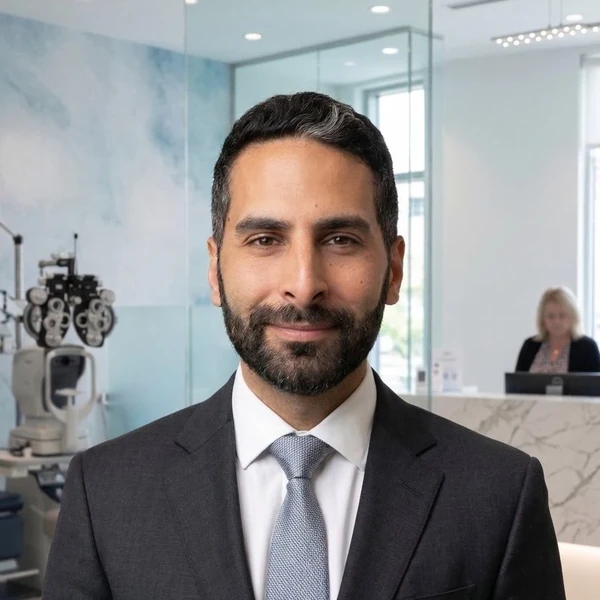
Once they pass sixty, many patients believe they have "missed the boat" to correct their near vision. Yet presbyopia surgery after 60 remains not only possible, but today delivers remarkable outcomes thanks to technological advances in refractive surgery. This article reviews the available techniques, the eligibility criteria and the real benefits for seniors who wish to regain visual independence without glasses.
Presbyopia surgery after 60: is it really too late?
The question of an age limit for presbyopia surgery comes up constantly in consultation. The answer is clear: there is no expiry date for correcting presbyopia surgically. Presbyopia surgery after 60 is performed daily in specialised centres. What determines eligibility is not the patient's chronological age, but the condition of their ocular structures — cornea, crystalline lens, retina — and the stability of their refraction. After 60, presbyopia is fully established, which is paradoxically an advantage: the required correction is definitive and predictable, unlike procedures carried out in younger patients whose presbyopia is still progressing.
Why consider presbyopia surgery after 60?
After six decades of life, dependence on progressive lenses or reading glasses becomes burdensome. Several reasons drive patients to seek presbyopia surgery after 60:
- Daily comfort: reading, cooking, DIY, a phone screen — so many simple gestures flow smoothly again without glasses;
- Physical activities: sport, hiking and swimming are made easier by the absence of external optical correction;
- Safety: clear vision without glasses reduces the risk of falls and improves driving;
- Overall quality of life: regaining visual independence contributes to the psychological and social well-being of seniors.
The techniques available for presbyopia surgery after 60
The choice of technique depends on a complete preoperative work-up. For presbyopia surgery after 60, three main options can be considered:
- Senior Presby-LASIK: corneal reshaping with a femtosecond laser to create a multifocal profile. This technique is particularly suited when the crystalline lens remains clear and corneal thickness is sufficient;
- Presby-PRK: a surface variant recommended for thin corneas. Recovery is slightly longer but long-term results are comparable;
- Multifocal implant after 60: replacement of the natural crystalline lens with a multifocal intraocular lens. This solution is preferred when an early cataract is present, which is common at this age, allowing both conditions to be treated at the same time.
Senior Presby-LASIK and Presby-PRK act on the cornea, whereas the multifocal implant after 60 acts inside the eye. Dr Gozlan determines the optimal strategy after a thorough examination of each patient.
Ideal candidates for presbyopia surgery after 60
Not every patient in their sixties is a candidate for refractive surgery. Here are the criteria that define a favourable profile for presbyopia surgery after 60:
- Clear lens or early cataract: a still-clear lens points towards Presby-LASIK, whereas an emerging opacity favours the multifocal implant;
- Healthy and sufficiently thick cornea: an essential condition for laser techniques (pachymetry above 500 µm);
- No progressive retinal disease: AMD, severe diabetic retinopathy or advanced glaucoma may constitute contraindications;
- Realistic motivation: the patient must understand that the goal is independence from glasses in most situations, without a guarantee of perfect vision at every distance;
- Refractive stability: the optical correction must not have varied significantly over the past twelve months.
What results can you expect from presbyopia surgery after 60?
Clinical studies and Dr Gozlan's experience show that advanced presbyopia surgery delivers very satisfying results in patients over 60. Around 85 to 90% of operated patients report being independent of glasses for everyday activities. Intermediate vision — computer screen, dashboard — is generally excellent. Near vision allows the reading of standard text. Some patients may need a light correction for very small print in low light. Presbyopia surgery after 60 offers a high satisfaction rate, comparable to that seen in younger patients, provided that preoperative selection is rigorous.
Specific risks and precautions of presbyopia surgery after 60
All surgery carries risks, and transparency with patients is essential. For presbyopia surgery after 60, certain additional precautions apply:
- Dry eye: more common after 60, it requires preventive treatment with artificial tears before and after the procedure;
- Night-time light halos: possible with multifocal profiles (laser or implant), they subside within a few weeks in the vast majority of cases;
- Progression to cataract: a patient treated with Presby-LASIK can later undergo cataract surgery with an implant without any particular difficulty;
- Possible touch-up: in 5 to 10% of cases, an additional laser adjustment can be performed to optimise the result.
When should you consult Dr Gozlan for presbyopia surgery after 60?
The ideal time to consult is as soon as visual discomfort affects your daily life. Do not wait for an advanced cataract to limit your surgical options. A specialised consultation makes it possible to carry out a complete work-up — corneal topography, ocular biometry, retinal OCT, tear test — and to determine whether you are eligible for presbyopia surgery after 60. The earlier the work-up, the more therapeutic options remain open.
📍 Consultation at the Paris – Auteuil Ophthalmology Practice
Dr Gozlan, an ophthalmic surgeon specialising in refractive surgery for presbyopia at the Paris – Auteuil Ophthalmology Practice, welcomes you for your assessment and your care.
Book an appointment on DoctolibFAQ: presbyopia surgery after 60 — frequently asked questions
Is there an age limit for presbyopia surgery after 60?
No, there is no strict age limit. Patients of 65, 70 or even 75 can be operated on successfully. Eligibility rests on the overall ocular condition, assessed during the preoperative work-up, and not on the patient's age.
Is presbyopia surgery after 60 painful?
The procedure is painless thanks to the instillation of anaesthetic eye drops. A sensation of moderate discomfort may occur in the hours following the procedure, particularly with Presby-PRK, but it is perfectly controlled with simple painkillers.
Can presbyopia surgery after 60 be combined with cataract treatment?
Absolutely. When an early cataract is detected, placing a multifocal implant after 60 makes it possible to correct presbyopia and lens opacification at the same time. It is a two-in-one solution that is particularly effective at this age.
What is the recovery time after presbyopia surgery after 60?
With Presby-LASIK, visual recovery is rapid: most patients regain functional vision as early as the next day. With Presby-PRK, the timeframe is three to five days. For the multifocal implant, vision improves gradually over two to four weeks.
Is presbyopia surgery after 60 reimbursed?
Pure refractive surgery is not covered by national health insurance. However, if the procedure includes treatment of a cataract with implant placement, part of the cost is reimbursed. Some complementary health insurers offer specific packages for refractive surgery.
Going further
- Presby-LASIK: the most widespread multifocal technique for presbyopia;
- Presby-PRK: an alternative for thin corneas;
- Presby-LASIK vs Presby-PRK comparison: all the differences explained.