
You have just undergone multifocal laser surgery to correct your presbyopia and you are wondering about the steps ahead? Recovery after Presby-LASIK follows a precise timeline, marked by gradual improvements and adaptation phases that every patient should understand. This article details, week by week, Presby-LASIK aftercare so you can move serenely through your convalescence.
Recovery after Presby-LASIK: understanding the first days
The first hours following the procedure are a critical phase of recovery after Presby-LASIK. As soon as you leave the operating room, a mild burning sensation, reflex tearing and moderate photophobia are common. These symptoms usually subside within four to six hours after the procedure. The corneal flap created during surgery immediately begins to heal, which is why it is essential not to rub your eyes during the early recovery after Presby-LASIK.
- Day 0: complete visual rest, wearing protective shields at night;
- Day 1: mandatory postoperative check-up;
- Days 2-3: light activities may resume, with blurred vision Presby-LASIK still frequent;
- Prescribed eye drops: antibiotics, anti-inflammatories and artificial tears according to the surgeon's protocol.
Week 1: the key steps of recovery after Presby-LASIK
During the first week, distance visual acuity often improves dramatically. Near vision, however, may still seem inconsistent. This fluctuation is normal within presbyopia laser visual adaptation: the brain must learn to interpret the multifocal profile sculpted onto the cornea. Blurred vision Presby-LASIK, particularly during prolonged reading or in low light, is a well-documented and transient phenomenon.
During this period, you should avoid eye make-up, swimming, dusty environments and any intense physical effort. Rigorous instillation of the eye drops remains essential to prevent inflammation and ocular dryness, two common hurdles in recovery after Presby-LASIK.
Weeks 2 to 4: progression of recovery after Presby-LASIK
Between the second and fourth week, most patients notice a clear improvement in their intermediate vision — computer screen, dashboard — and in their near vision. Recovery after Presby-LASIK reaches an important milestone here: roughly 80% of the target visual acuity is generally achieved. Nighttime halos and glare, frequent in the first days, begin to diminish noticeably.
- Ocular dryness: still present in some patients, it requires continuing artificial tears;
- Refractive stabilisation: the cornea continues to remodel, and acuity measurements may vary from one check-up to the next;
- Return to sport: non-contact activities are generally allowed from the third week;
- Night driving: to be resumed cautiously depending on the visual comfort you feel.
Months 1 to 3: neuroadaptation in recovery after Presby-LASIK
The neuroadaptation phase is one of the most specific aspects of Presby-LASIK aftercare. Unlike a conventional LASIK for myopia, Presby-LASIK creates a multifocal corneal profile that requires active cortical work. The brain gradually learns to select the sharpest image according to the viewing distance. This presbyopia laser visual adaptation can take four to twelve weeks depending on the individual.
During this period, daily reading exercises at different distances help speed up the process. Recovery after Presby-LASIK is considered satisfactory when the patient can spontaneously alternate between distance, intermediate and near vision without conscious effort.
Recovery after Presby-LASIK vs Presby-PRK convalescence: what are the differences?
It is helpful to compare recovery after Presby-LASIK with Presby-PRK convalescence, because the two techniques have distinct postoperative profiles. In Presby-PRK, the absence of a corneal flap means longer epithelial healing — often three to five days — accompanied by more pronounced pain. Complete visual stabilisation may require two to three additional months compared with Presby-LASIK.
- Postoperative pain: moderate to strong in Presby-PRK, mild in Presby-LASIK;
- Return to activity: one week with Presby-LASIK versus two to three weeks with Presby-PRK;
- Final refractive stability: reached around the third month with Presby-LASIK, around the sixth month in Presby-PRK convalescence;
- Risk of corneal haze: non-existent in Presby-LASIK, possible in Presby-PRK and prevented with mitomycin C.
Recovery after Presby-LASIK: practical tips to optimise results
Several simple measures help optimise recovery after Presby-LASIK and speed up the return to comfortable vision. Scrupulous adherence to the eye-drop schedule is fundamental. Regular hydration of the ocular surface with preservative-free artificial tears limits postoperative dryness, a major factor of discomfort during recovery after Presby-LASIK.
- Sun protection: wear anti-UV glasses for the first three months;
- Screens: follow the 20-20-20 rule (every 20 minutes, look at something 20 feet away for 20 seconds);
- Sleep: keep the eye shields on at night during the first week;
- Medical follow-up: do not miss any check-up at D1, D7, M1 and M3.
When to consult Dr Gozlan for recovery after Presby-LASIK?
Certain signs should prompt a prompt consultation outside scheduled appointments during your recovery after Presby-LASIK: sudden intense pain, abrupt drop in vision, marked redness, purulent discharge or the perception of light flashes. Although rare, these symptoms may indicate a flap displacement, an infection or significant inflammation requiring immediate care. Dr Gozlan provides personalised follow-up for every operated patient to ensure the best possible Presby-LASIK aftercare.
📍 Consultation at the Paris – Auteuil Ophthalmology Practice
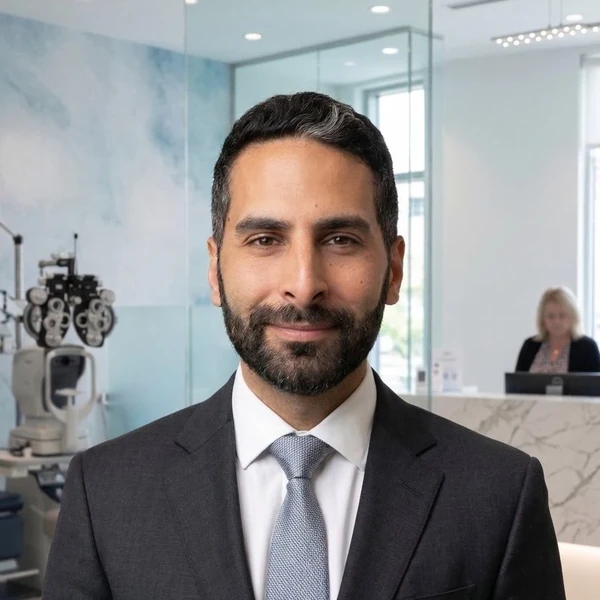
Dr Gozlan, an ophthalmic surgeon specialised in refractive surgery for presbyopia at the Paris – Auteuil Ophthalmology Practice, welcomes you for your assessment and treatment.
Book an Appointment on DoctolibFAQ: recovery after Presby-LASIK — frequently asked questions
How long does recovery after Presby-LASIK last?
Functional vision is generally regained within one to two weeks. However, complete stabilisation and neuroadaptation can take one to three months depending on the patient's profile and the degree of presbyopia corrected.
Is blurred vision after Presby-LASIK normal?
Yes, blurred vision Presby-LASIK is a very common transient phenomenon, particularly for near vision during the first weeks. It reflects the time the brain needs to adapt to the cornea's new multifocal profile.
Can you drive during recovery after Presby-LASIK?
Daytime driving is generally possible from the end of the first week, provided sufficient acuity has been confirmed at the postoperative check-up. Night driving should be resumed cautiously because of temporary halos and glare.
What factors influence the duration of recovery after Presby-LASIK?
The patient's age, the degree of presbyopia, the quality of the tear film and the presence of an associated refractive error (myopia, hyperopia, astigmatism) are the main factors. Rigorous follow-up and adherence to postoperative instructions speed up recovery after Presby-LASIK.
Is recovery after Presby-LASIK painful?
Pain is generally minimal, limited to discomfort or a grain-of-sand sensation for a few hours. This postoperative comfort distinguishes Presby-LASIK from Presby-PRK convalescence, which is usually more uncomfortable in the first days.
Further reading
- Presby-LASIK: the most widespread multifocal technique for presbyopia;
- Presby-PRK: an alternative for thin corneas;
- Presby-LASIK vs Presby-PRK comparison: all the differences explained.