
Does laser presbyopia surgery mean never wearing glasses again? The honest answer is nuanced. Presby-LASIK and Presby-PRK reshape the cornea in a generally stable way, but presbyopia itself keeps progressing with age. Here is what you can reasonably expect, and what surgery cannot promise.
Why does presbyopia progress?
Presbyopia is caused by ageing of the crystalline lens, which gradually loses its flexibility and therefore its ability to focus up close (accommodation). This physiological process starts around age 40-45 and continues until roughly 60-65 [1, 2]. Reading glasses compensate for it without treating it, and their power has to be increased over the years.
What laser surgery does
Presby-LASIK and Presby-PRK reshape the cornea to increase depth of field, either with a multifocal profile or with a slight difference in focus between the two eyes (micro-monovision) [3, 4]. In eligible patients, the aim is to reduce dependence on glasses for most everyday activities while preserving distance vision. Associated myopia, hyperopia or astigmatism can be corrected at the same time.
Results vary from person to person. Occasional glasses are sometimes still useful, for example for prolonged reading in dim light, and night vision may be less comfortable during the first weeks. The procedure is performed under eye-drop anaesthesia; temporary discomfort is possible afterwards, particularly after Presby-PRK.
Is the correction long-lasting?
The corneal reshaping is generally stable over time. However, the lens keeps ageing after surgery, so near vision may gradually decline over the years, especially when surgery is performed before presbyopia has stabilised [3]. This is not a failure of the surgery but the natural evolution of the eye, explained in our article on presbyopia recurrence after laser surgery.
Depending on the case, several options can then be discussed: a laser enhancement if corneal thickness allows, occasional glasses, or later, when the lens becomes cloudy (cataract), lens surgery with an intraocular implant.
Glasses, contact lenses or surgery: how to choose?
- Reading or progressive glasses: no surgical risk, to be updated as the prescription changes;
- Multifocal contact lenses: a reversible alternative, with tolerance varying between individuals;
- Presby-LASIK or Presby-PRK: a surgical option for eligible patients, with benefits and risks to be assessed during the evaluation;
- Lens surgery: generally considered after age 60 or when a cataract is starting.
No option is better in absolute terms. The pre-operative assessment (corneal topography and thickness, refraction, monovision trial, examination of the lens and retina) determines whether surgery is indicated, which one, and what is realistic for your eyes.
📍 Consultation at the Paris – Auteuil Ophthalmology Practice
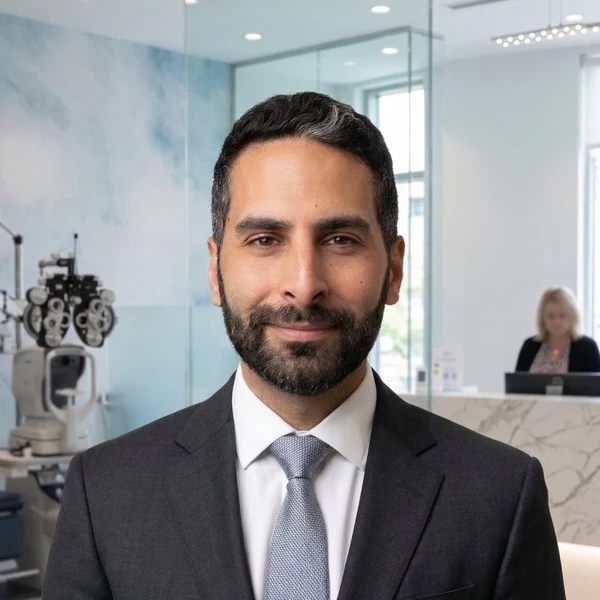
Dr Gozlan, an ophthalmologist in Paris 16 practising refractive surgery, will see you for an assessment and explain the options suited to your situation.
Book an Appointment on DoctolibFAQ: presbyopia surgery and how long it lasts
Does presbyopia surgery correct vision forever?
Not necessarily. The corneal reshaping is generally stable, but presbyopia keeps progressing until about age 60-65, so near vision may decline over the years. No result can be guaranteed: the assessment helps estimate what is realistic for your eyes.
Will I be able to do without glasses entirely?
The aim is to reduce dependence on glasses for most activities. Some patients keep occasional glasses for specific tasks or in dim light, and this need may increase with age.
What if near vision declines a few years later?
A new examination identifies the cause. Depending on the situation, a laser enhancement, occasional glasses or lens surgery can be discussed.
Sources
- Glasser A, Campbell MCW. Presbyopia and the optical changes in the human crystalline lens with age. Vision Research. 1998;38(2):209-229.
- Charman WN. The eye in focus: accommodation and presbyopia. Clinical and Experimental Optometry. 2008;91(3):207-225.
- Vargas-Fragoso V, Alió JL. Corneal compensation of presbyopia: PresbyLASIK: an updated review. Eye and Vision. 2017;4:11.
- Reinstein DZ, Archer TJ, Gobbe M. LASIK for myopic astigmatism and presbyopia using non-linear aspheric micro-monovision with the Carl Zeiss Meditec MEL 80 Platform. Journal of Refractive Surgery. 2011;27(1):23-37.
Further reading
- Presby-LASIK: the most widespread multifocal technique for presbyopia;
- Presby-PRK: an alternative for thin corneas;
- Presby-LASIK vs Presby-PRK comparison: all the differences explained.