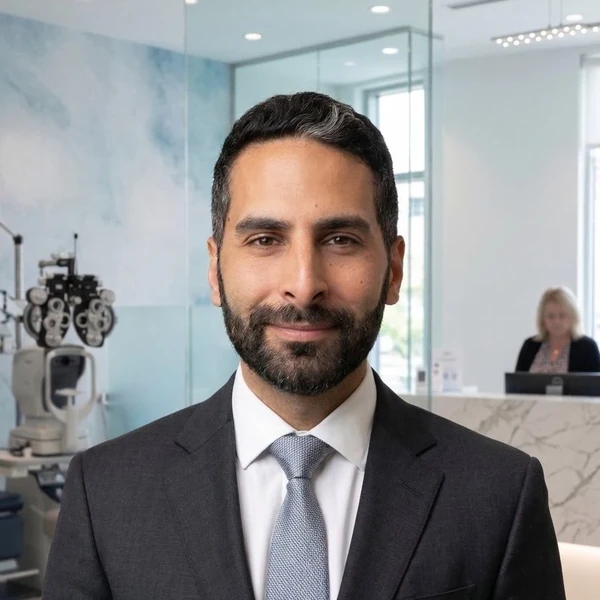
Surface laser presbyopia surgery, ideal for thin corneas and athletes, in Paris, with Dr Gozlan.
Presby-PKR is a gold-standard technique for laser presbyopia surgery when Presby-LASIK is not suitable. Performed on the corneal surface without creating a flap, it restores comfortable near vision and is particularly well suited for thin corneas and individuals exposed to ocular trauma. Dr Gozlan, an ophthalmologist and refractive surgeon holding a University Diploma in Refractive Surgery and Phacoemulsification (University of Toulouse), explains the principle, indications, procedure, recovery, outcomes, risks and cost of this surgery.
Presby-PKR is a variant of PKR (photorefractive keratectomy) designed to correct presbyopia. Unlike LASIK, no corneal flap is created : the thin surface layer of cells covering the cornea, the epithelium, is simply removed, and the excimer laser then reshapes the corneal surface. The difference from a standard PKR lies in the sculpted profile : the laser shapes a multifocal cornea or applies a micro-monovision approach to restore near vision. The epithelium regenerates naturally within a few days. The procedure takes approximately ten minutes per eye and is performed on an outpatient basis.
Presbyopia is a natural age-related change in the eye. Over time, the crystalline lens loses its flexibility and the eye can no longer accommodate — that is, focus at close range. Reading and screens become blurry, and you find yourself holding text further away to see it clearly. Presbyopia typically begins around age 45 and progresses until approximately age 60. Presby-PKR does not rejuvenate the crystalline lens : it modifies the optics of the corneal surface to compensate for this loss of accommodation.
Presby-PKR is intended for presbyopic patients who wish to become free from reading glasses and whose vision is stable. It is particularly recommended :
For very advanced presbyopia or a lens that is becoming cloudy, crystalline lens surgery may be preferable. Only a comprehensive pre-operative assessment can determine the safest technique.
Like Presby-LASIK, Presby-PKR treats multiple vision defects in the same session. Many presbyopic patients are also myopic, hyperopic or astigmatic ; the same laser treatment corrects :
No surgery is performed without a thorough, painless pre-operative assessment. Before Presby-PKR, it includes :
As with any refractive surgery, contact lenses must be removed several days to several weeks before the assessment to avoid distorting the measurements.
Presby-PKR is performed on an outpatient basis, without hospitalisation, in six steps. You remain awake ; the procedure takes approximately ten minutes per eye.
The main distinctive feature of Presby-PKR is its recovery, which is more gradual than that of Presby-LASIK. During the 2 to 3 days of epithelial regrowth, discomfort, watering eyes and significant light sensitivity are common ; these are relieved by painkillers, eye drops and the bandage contact lens. In addition, the brain needs time to adapt to multifocal vision :
Presby-PKR works on the cornea and is suitable when the natural lens is still clear. When presbyopia is very advanced or an early cataract is developing, it may be more appropriate to replace the natural lens with a suitable intraocular implant : this is lens replacement surgery, which involves a different treatment pathway. The preoperative assessment guides the patient towards the most long-lasting solution based on age, refractive error and the condition of the natural lens.
Presby-PKR and Presby-LASIK correct presbyopia using the same optical principle, but Presby-PKR works on the surface while Presby-LASIK operates beneath a corneal flap. The difference is mainly felt during recovery : longer and somewhat uncomfortable in the first few days with Presby-PKR, very rapid with Presby-LASIK. On the other hand, the absence of a flap makes Presby-PKR safer for thin corneas and impact-prone activities.
Presby-PKR delivers excellent near-vision results, equivalent in the long term to those of Presby-LASIK. The vast majority of patients are once again able to read without glasses for everyday activities, while maintaining good distance vision. The outcome is stable, but does not prevent subsequent age-related changes in the natural lens.
Surface laser surgery is a safe and well-established procedure with over thirty years of proven track record. Complications are rare and most often temporary :
Strict adherence to contraindications and a thorough preoperative assessment reduce these risks to a minimum.
The procedure is not performed in the presence of : progressive keratoconus, unstable refraction, significant cataract, severe dry eye disease, or certain corneal or autoimmune conditions. In cases of cataract or very advanced presbyopia, lens replacement surgery is often preferable.
As with Presby-LASIK, the procedure is not covered by the French national health insurance (Assurance Maladie) as it is considered an elective treatment. Many complementary health insurance plans offer a "refractive surgery" package that covers all or part of the cost. The price depends on the correction required and the technique used ; a transparent quote is provided at your preoperative consultation, with no obligation.
The absence of a corneal flap makes Presby-PKR the technique of choice for contact sports participants (boxing, rugby, martial arts) and professionals exposed to ocular trauma (firefighters, military personnel, law enforcement), where a flap could theoretically be displaced by a direct impact. This is one of the major advantages of Presby-PKR over Presby-LASIK for these presbyopic profiles.
The procedure itself is painless (anaesthesia with eye drops). However, during the 2 to 3 days of epithelial regrowth, discomfort, tearing and light sensitivity are common; analgesics and a bandage contact lens provide relief.
Yes, that is its goal. The laser gives the cornea a multifocal profile or applies micro-monovision to restore near vision while preserving distance vision. Most patients no longer need reading glasses in daily life.
Recovery is more gradual than after presby-LASIK: functional vision returns within a few days, then refines over 2 to 4 weeks. In addition, the brain needs time to adapt to multifocal vision.
Presby-PRK is preferred when the cornea is too thin for a flap, in cases of irregular cornea, or for contact-sport athletes and professions exposed to ocular trauma, as no flap is created.
Yes. Presby-PRK corrects presbyopia and, during the same session, any associated myopia, astigmatism or hyperopia.
Presbyopia results from ageing of the crystalline lens, which continues over time. The surface correction provides long-lasting relief from near-vision difficulty; if the lens becomes cloudy with age (cataract), lens surgery can take over.
Work can generally be resumed 3 to 7 days after presby-PRK. Non-contact sports after one week, swimming and combat sports after 2 to 3 weeks.
Presby-PRK is intended for presbyopic patients, most commonly from the age of 45–50, whose refraction is stable. When the crystalline lens has already significantly deteriorated, lens surgery may be preferable.
Dr Gozlan, holder of a University Diploma in Refractive Surgery and Phacoemulsification, assesses your eligibility for presby-PRK during a comprehensive evaluation and determines with you the technique best suited to your eyes.
Book an appointment on Doctolib