
Are you holding your phone further away to read, and does your glasses prescription also mention astigmatism? This is common: presbyopia and astigmatism are two different conditions that can add up. Here is what sets them apart, how they combine in daily life and what laser presbyopia surgery can take into account. The surgeon assesses each situation during the pre-operative assessment.
Presbyopia and astigmatism: two different conditions
Presbyopia is age-related: the crystalline lens, the natural lens behind the iris, gradually loses its ability to focus up close. It usually becomes noticeable from the age of 40-45 and affects everyone, with or without another vision problem [3]. The mechanisms are explained in the article Why does presbyopia appear after age 40?
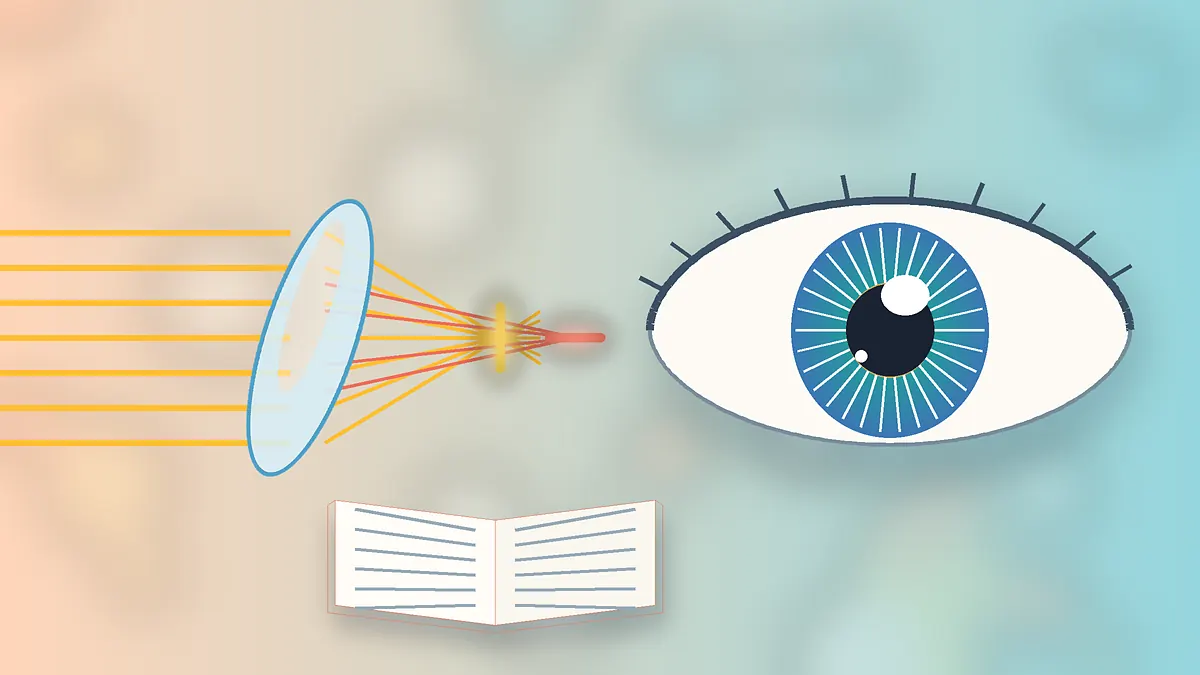
Astigmatism is a shape problem: the cornea, or less often the lens, is not perfectly round but slightly oval, like a rugby ball rather than a football. Light rays then do not focus on a single point on the retina, and vision is blurred or distorted, both far and near [1]. Astigmatism is very common, often associated with myopia or hyperopia, and partly inherited [1, 2].
The two can therefore coexist: long-standing astigmatism does not disappear when presbyopia sets in, and it can itself change over a lifetime [1, 2].
Reading your prescription: sphere, cylinder, axis and addition
- the sphere indicates myopia (minus sign) or hyperopia (plus sign);
- the cylinder indicates the power of the astigmatism, in dioptres;
- the axis indicates its orientation, between 0 and 180° [1];
- the addition is the extra correction needed to see up close: it reflects presbyopia.
A prescription with both a cylinder and an addition therefore indicates astigmatism and presbyopia.
Why astigmatism matters when presbyopia sets in
With presbyopia, near vision becomes more demanding, and uncorrected astigmatism adds its own blur. In an experimental study of 21 presbyopic adults, astigmatism induced with lenses, even around one dioptre, reduced distance and near visual acuity as well as reading speed [4].
In everyday life, this can show up as:
- letters that look smeared or doubled, especially in low light;
- eye strain or headaches after reading or screen use;
- squinting to see more sharply [1].
These signs are not specific: only an eye examination can identify the cause [1]. Note that ready-made reading glasses have the same power in every direction and do not correct astigmatism, unlike prescription glasses.
Regular or irregular astigmatism: an essential difference
Regular astigmatism is the most common: the cornea has two main curvatures, at right angles to each other. It can be corrected with glasses, toric contact lenses or, in some cases, refractive surgery [1].
Irregular astigmatism means the cornea is asymmetrically distorted, for example with keratoconus, a scar or after eye surgery [1]. It is not corrected in the same way and changes the surgical discussion.
This is why the shape of the cornea is mapped before any laser surgery. In a study published in Ophthalmology covering 171 cases of ectasia (a progressive bulging of the cornea after refractive surgery), abnormal corneal topography before surgery was the factor that most distinguished these patients from those without complications [5]. Early keratoconus, even without symptoms, is a contraindication to laser: the pre-operative assessment is designed, among other things, to detect it.
Can presbyopia and astigmatism be corrected at the same time with laser?
Laser techniques for presbyopia, such as Presby-LASIK and Presby-PRK, reshape the cornea. In addition to correcting presbyopia, the treatment profile can include the correction of associated myopia, hyperopia or astigmatism [6]. When astigmatism is regular and the cornea is suitable, it can therefore, depending on its degree, be addressed in the same treatment.
A published series of 155 presbyopic patients with myopic astigmatism, treated with LASIK micro-monovision (one eye set for distance, the other slightly for near) and followed for about a year, reported that the treatment was well tolerated and the refraction stable over that period, with outcomes assessed after any enhancements [7]. However, this is a single-centre series without a comparison group: it cannot predict the result for any given person. The principle of micro-monovision is explained in the article Monovision and presbyopia.
Several factors guide the surgeon's proposal: the degree and regularity of the astigmatism, the thickness and shape of the cornea, the quality of the tear film, the condition of the lens and your visual needs. The result varies and is not guaranteed: glasses may still be useful for some tasks, and eyesight can continue to change over the years, as explained in the article Can presbyopia recur after laser surgery?
What if you are also short-sighted?
Myopia, astigmatism and presbyopia often occur together. The article Presbyopia and myopia: Can both be corrected at once with laser? covers this situation in detail.
When the lens is involved
If a cataract is found, the question is different: in cataract surgery, the lens is replaced by an implant. So-called toric implants are designed to compensate for regular corneal astigmatism. A meta-analysis of 13 randomised trials found, with these implants, sharper uncorrected distance vision on average and less need for distance glasses than with non-toric implants [8]. The different types of implants are described in the article Trifocal lenses, EDOF lenses or laser: what are the differences for presbyopia?
What the pre-operative assessment checks
No proposal is made without a complete pre-operative assessment. For presbyopia combined with astigmatism, it includes in particular:
- refraction, which measures the sphere, the cylinder and its axis, checked if needed after dilating the pupil;
- corneal topography and tomography, which map its shape and detect early keratoconus;
- pachymetry, which measures the thickness of the cornea;
- examination of the eye surface and tears;
- near vision and the dominant eye, with a micro-monovision trial if needed.
If you wear contact lenses, especially rigid ones, they must be removed before the assessment, within the time frame you will be given, because they temporarily change the shape of the cornea and distort the measurements.
Pre-operative tests take place at 4, rue Donizetti, 75016 Paris, Monday to Thursday from 9 am to 6 pm, at a time that suits you. Based on the results, the surgeon tells you whether laser surgery is possible, which technique he proposes and what can realistically be expected. If a laser is chosen, the process is described on the page Day of surgery and the fees on the page Fees.
FAQ: presbyopia and astigmatism
Can I have presbyopia surgery if I have astigmatism?
Regular astigmatism does not in itself rule out laser presbyopia surgery: depending on its degree, it can be addressed in the same treatment [6]. However, irregular astigmatism caused by keratoconus is a contraindication to laser. Only the assessment allows the surgeon to answer for your eyes.
Should mild astigmatism be corrected?
Not necessarily, but it should not be overlooked: in presbyopic people, uncorrected astigmatism of about one dioptre is enough to reduce sharpness and reading speed [4]. The surgeon takes this into account in the proposal.
Can astigmatism come back after surgery?
Astigmatism can change over a lifetime [1, 2], and presbyopia also continues to progress with age. Follow-up visits after surgery make it possible to monitor your eyesight; no technique guarantees vision that stays fixed over time.
Are ready-made reading glasses enough if I have astigmatism?
Ready-made reading glasses do not correct astigmatism. Prescription glasses can correct it at the same time as presbyopia. An eye examination will clarify your situation.
Presby-LASIK or Presby-PRK with astigmatism?
It is not up to the patient to choose. Both techniques reshape the cornea and can include the correction of associated astigmatism; the surgeon proposes one or the other depending in particular on the thickness and shape of the cornea, measured during the assessment. The differences are presented in the Presby-LASIK and Presby-PRK comparison.
Sources
- American Academy of Ophthalmology. What Is Astigmatism? EyeSmart, aao.org. aao.org
- Read SA, Collins MJ, Carney LG. A review of astigmatism and its possible genesis. Clinical and Experimental Optometry. 2007;90(1):5-19. PubMed 17177660
- Charman WN. The eye in focus: accommodation and presbyopia. Clinical and Experimental Optometry. 2008;91(3):207-225. PubMed 18336584
- Wolffsohn JS, Bhogal G, Shah S. Effect of uncorrected astigmatism on vision. Journal of Cataract and Refractive Surgery. 2011;37(3):454-460. PubMed 21333869
- Randleman JB, Woodward M, Lynn MJ, Stulting RD. Risk assessment for ectasia after corneal refractive surgery. Ophthalmology. 2008;115(1):37-50. PubMed 17624434
- Vargas-Fragoso V, Alió JL. Corneal compensation of presbyopia: PresbyLASIK: an updated review. Eye and Vision. 2017;4:11. PubMed 28413804
- Reinstein DZ, Archer TJ, Gobbe M. LASIK for myopic astigmatism and presbyopia using non-linear aspheric micro-monovision with the Carl Zeiss Meditec MEL 80 Platform. Journal of Refractive Surgery. 2011;27(1):23-37. PubMed 20205360
- Kessel L, Andresen J, Tendal B, et al. Toric intraocular lenses in the correction of astigmatism during cataract surgery: a systematic review and meta-analysis. Ophthalmology. 2016;123(2):275-286. PubMed 26601819
Further reading
- Techniques: Presby-LASIK and Presby-PRK, principle and procedure;
- Pre-operative assessment: what is measured before any proposal;
- Am I a candidate?: the criteria checked before presbyopia surgery;
- Presbyopia and myopia: correcting both at the same time with laser;
- What is presbyopia?: symptoms, progression and solutions.