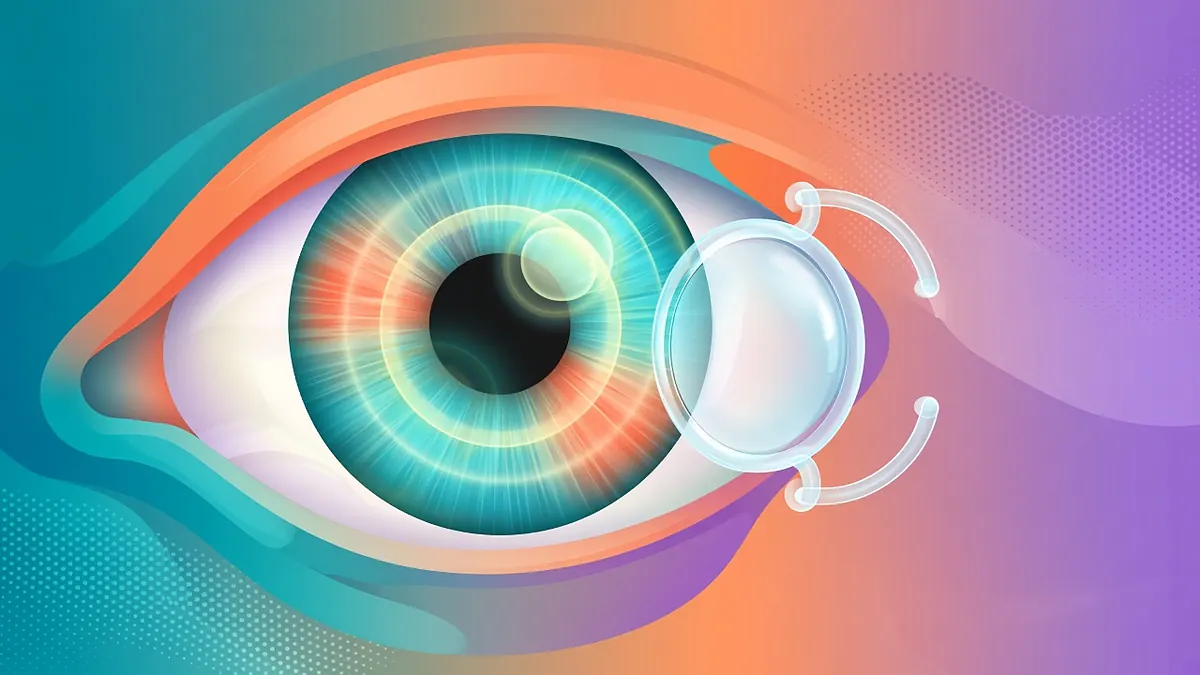

When you read up on presbyopia surgery, you soon come across intriguing terms: trifocal lens, EDOF lens, PRELEX, clear lens exchange. These techniques do not work on the same part of the eye as Presby-LASIK or Presby-PRK. Here is what sets them apart, what published studies show, and why it is the surgeon who proposes the appropriate approach after the preoperative assessment.
Cornea or crystalline lens: two ways of treating presbyopia
Presbyopia is caused by ageing of the crystalline lens, the natural lens behind the iris, which gradually loses its ability to focus up close [1]. There are two main families of surgery:
- Laser on the cornea (Presby-LASIK, Presby-PRK): the crystalline lens is left in place and the cornea is reshaped to increase depth of field, using a multifocal profile or micro-monovision [1]. These techniques are described on the Techniques page.
- Lens surgery: the crystalline lens is removed and replaced by an implant (an artificial lens placed inside the eye). When the lens is still clear, this is called clear lens exchange, or PRELEX; when it has become cloudy, it is cataract surgery [1, 5].
These two approaches have neither the same indications nor the same risks. They are not in competition: they address different situations.
Lens implants that correct presbyopia
Monofocal lenses, possibly in monovision
This is the most common implant in cataract surgery. It gives sharp vision at a single distance, usually far; glasses are then still useful for reading. One variant is to set one eye for distance and the other slightly more for near (monovision), on the same principle as described in our article on monovision and presbyopia [2].
Multifocal lenses: bifocal and trifocal
These lenses split light between several focal points: two for a bifocal lens (distance and near), three for a trifocal lens (distance, intermediate and near) [3]. The brain then learns to use the sharp image matching the distance being viewed: this is neuroadaptation, which usually takes a few weeks.
EDOF lenses (extended depth of focus)
Instead of several separate focal points, an EDOF lens (extended depth of focus) creates an elongated focus that extends the range of clear vision from distance towards intermediate. This principle aims to limit the halos and glare described with multifocal lenses. Many models, however, combine several optical principles, which causes some confusion between categories [4].
What studies show
- Multifocal or monofocal. A Cochrane review of 20 randomised trials concludes that multifocal lenses improve near vision and reduce the need for glasses, with comparable distance vision, but at the cost of more frequent halos and glare. The authors stress that the balance of benefits and drawbacks varies from one person to another [2].
- Trifocal or EDOF. A meta-analysis of 22 studies (2,200 eyes) found better uncorrected near vision on average with trifocal lenses, with no significant difference in distance vision, intermediate vision, halos or glare [6].
- Overview. An overview of systematic reviews published in 2025 points in the same direction: similar distance vision between lenses, better near vision with multifocal lenses, but more halos and glare with trifocal and bifocal lenses [7].
No lens reproduces the accommodation of a young eye. Each model is a compromise between the range of clear vision and quality of vision, especially at night, which echoes what we explain about night driving after presbyopia surgery.
Clear lens exchange (PRELEX): what you should know
Removing a lens that is still clear is irreversible. A recent review points out that this surgery can be discussed in carefully selected patients, but that its complications must be taken seriously [5]:
- a gap between the intended and the achieved correction (refractive surprise);
- halos or glare linked to multifocal lenses, and sometimes insufficient adaptation of the brain;
- retinal detachment, the most serious complication, of greater concern in young patients and people with high myopia;
- macular oedema (swelling of the central area of the retina) or clouding of the capsule that holds the implant, usually treated with a laser.
Timing matters too: for someone in their fifties whose lens is clear, the balance between benefits and risks is not the same as for an older person with early cataract. Our article on presbyopia surgery after 60 covers these situations in detail.
Laser or lens: the surgeon makes the proposal
Patients do not have to choose between a laser and a lens implant themselves, nor between two lens models. During the preoperative assessment, several factors are examined: the transparency of the crystalline lens, the condition of the retina, the shape and thickness of the cornea, the starting prescription (myopia, hyperopia, astigmatism), dry eye, age and everyday visual needs.
Based on these measurements, the surgeon indicates whether surgery is reasonable, which procedure he proposes, and what can realistically be expected, without any guarantee of results. If laser is chosen, the procedure is described on the Day of surgery page and the fees on the Fees page.
FAQ: lens implants and presbyopia
What is the difference between a trifocal lens and an EDOF lens?
A trifocal lens splits light between three focal points (distance, intermediate, near). An EDOF lens creates an elongated focus that mainly extends vision from distance towards intermediate. In studies, uncorrected near vision is better on average with trifocal lenses; both remain compromises [6].
Does a lens implant mean never wearing glasses again?
No, this is not guaranteed. Multifocal lenses reduce the need for glasses in many patients, but some still use them for specific tasks or in low light, and halos may occur, especially at night [2].
Why not operate on the lens at the first signs of presbyopia?
Because removing a clear lens is irreversible and carries its own risks, such as retinal detachment, of greater concern in young patients and people with high myopia [5]. Depending on the cornea and the starting prescription, laser on the cornea may be proposed instead; the assessment is what allows this decision.
After Presby-LASIK, can I have a lens implant later?
Yes, cataract surgery remains possible after corneal laser surgery. It is then useful to keep the operative report and the corneal measurements from before the laser, which are used to calculate the power of the implant.
Sources
- Wolffsohn JS, Davies LN. Presbyopia: effectiveness of correction strategies. Progress in Retinal and Eye Research. 2019;68:124-143.
- de Silva SR, Evans JR, Kirthi V, Ziaei M, Leyland M. Multifocal versus monofocal intraocular lenses after cataract extraction. Cochrane Database of Systematic Reviews. 2016;12:CD003169.
- Alió JL, Plaza-Puche AB, Fernández-Buenaga R, Pikkel J, Maldonado M. Multifocal intraocular lenses: an overview. Survey of Ophthalmology. 2017;62(5):611-634.
- Kanclerz P, Toto F, Grzybowski A, Alió JL. Extended depth-of-field intraocular lenses: an update. Asia-Pacific Journal of Ophthalmology. 2020;9(3):194-202.
- Medalle RS, Salmoral Lorenzo-Arroyo A, Alió del Barrio JL. Complications of refractive lens exchange. Archivos de la Sociedad Española de Oftalmología. 2026 (published online, October 2026).
- Karam M, Alkhowaiter N, Alkhabbaz A, et al. Extended depth of focus versus trifocal for intraocular lens implantation: an updated systematic review and meta-analysis. American Journal of Ophthalmology. 2023;251:52-70.
- Daka Q, Henein C, Fang CEH, et al. Effectiveness of intraocular lenses designed to correct presbyopia after cataract surgery: an overview of systematic reviews. British Journal of Ophthalmology. 2025;109(12):1323-1329.
Further reading
- Techniques: Presby-LASIK and Presby-PRK, principle and procedure;
- Treatments: glasses, contact lenses, laser and lens implants;
- The preoperative assessment: what is measured before any proposal;
- Am I a candidate?: the criteria examined before presbyopia surgery;
- Presby-LASIK vs Presby-PRK: the differences between the two lasers.